
Bimatoprost Side Effects: What the Label Reports and When to Seek Help
The most common bimatoprost side effects are eye itching, eye redness, and darkening of the eyelid skin, each reported in roughly 3% to 4% of people in the main eyelash trial. Less common effects include eye irritation, dry eye symptoms, and redness around the eye. The effect that deserves the most attention is increased brown pigmentation of the iris, which the label describes as likely to be permanent.
This guide goes through what the official US prescribing information for the eyelash product (Latisse, bimatoprost ophthalmic solution 0.03%) says about side effects, which ones are expected to fade, which are not, and which symptoms call for prompt medical advice. It is general information, not a diagnosis, and it does not replace advice from an eye-care professional.
Before You Start: Where These Numbers Come From
Every figure in this article comes from the prescribing information for one specific prescription product, revised in July 2024. That matters for two reasons.
- Clinical trial rates are not real-world rates. The label itself warns that adverse reaction rates from trials cannot be directly compared with other drugs and may not reflect what happens in everyday use.
- Other products are not covered. A cosmetic serum, a differently formulated eye drop, or a product bought from an unverified seller does not have this label behind it. Its risks may be different, and its labeling may be incomplete. Our guide to prescription versus over-the-counter lash serums explains why the two categories should not be treated as interchangeable.
The main trial behind the data was a multicenter, double-masked, randomized, vehicle-controlled study of 278 adults treated for four months. Most reported reactions in that study occurred in fewer than 4% of participants.
Side Effects at a Glance
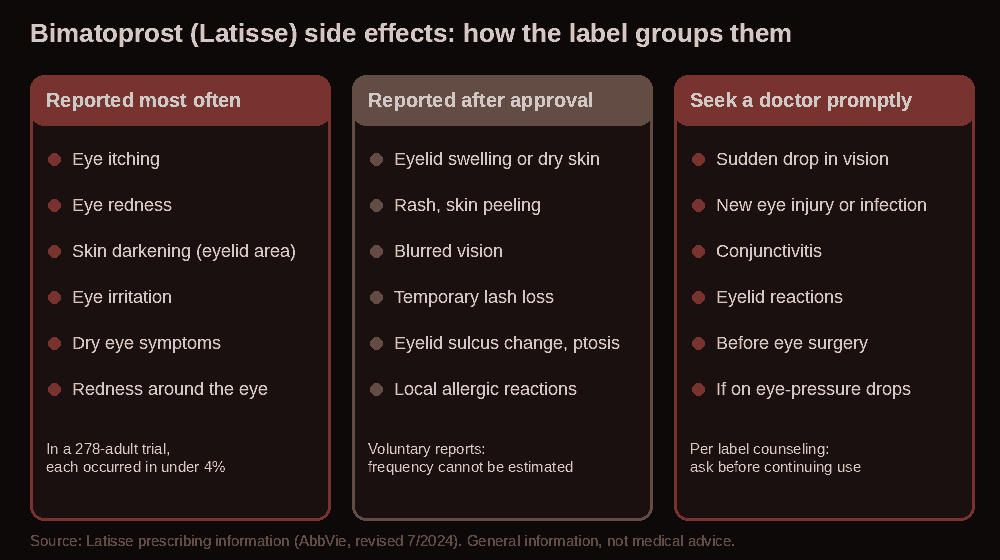
The graphic below sorts the effects named in the label into three groups: those reported most often in the trial, those reported voluntarily after the product reached the market, and situations in which the label advises seeking medical advice promptly.
The Most Common Effects
Eye Itching and Redness
The two effects reported most often are an itching sensation in the eyes and eye redness (conjunctival hyperemia in medical terms). The patient information describes them as the most common side effects, reported in approximately 4% of patients. For most people these are mild, but persistent or worsening redness, especially with swelling, discharge, or pain, is a reason to stop and ask a clinician rather than wait.
Skin Darkening Around the Eye
Skin hyperpigmentation was also among the most frequently reported reactions. The label says bimatoprost has been reported to darken periorbital pigmented tissues and eyelashes, and that the darkening is expected to increase as long as the medicine is used. In most patients it has been reported to be reversible after stopping, and the patient information says eyelid skin darkening is expected to reverse over several weeks to months.
Irritation, Dryness, and Redness of the Eyelids
Other reactions seen in the trial included ocular irritation, dry eye symptoms, and periorbital erythema (redness of the skin around the eye), each in fewer than 4% of patients. Foreign body sensation, abnormal hair growth, and iris hyperpigmentation were also noted in the clinical trial experience.
People who already have dry or sensitive eyes should be especially careful, because these effects can overlap with symptoms they already live with. Our overview of lash serum side effects covers reactions to cosmetic products that can look similar.
The Effect That Needs the Most Thought: Iris Pigmentation
The label states that increased iris pigmentation has occurred when bimatoprost solution was administered, and that the brown pigmentation is likely to be permanent. Several details are worth understanding.
- It can be slow to appear. Iris color changes may not be noticeable for several months to years.
- The change is in pigment, not in cell number. The label explains that the change is due to increased melanin content in the melanocytes, not an increase in the number of melanocytes.
- It spreads in a typical pattern. The brown pigmentation around the pupil usually spreads outward toward the edge of the iris, and the whole iris or parts of it can become more brown.
- Freckles and nevi seem unaffected. The label says neither nevi nor freckles of the iris appear to be affected.
- Long-term effects are unknown. The label states plainly that the long-term effects of increased pigmentation are not known.
The patient information is direct about the contrast with eyelid skin: lid darkening may reverse, while darkening of the colored part of the eye is not expected to reverse and is likely permanent. Anyone with light-colored eyes who cares about their appearance should weigh this before starting, and should discuss it with a prescriber.
Less Common Effects Reported After Approval
Once a product is on the market, doctors and patients report further reactions voluntarily. The label lists the following as identified during postapproval use of the eyelash product:
- Dry skin of the eyelid or the area around the eye
- Eye swelling, eyelid swelling, and styes (hordeolum)
- Local allergic reactions
- Increased tearing
- Temporary loss of a few lashes up to sections of lashes, and temporary lash breakage
- Rash, skin discoloration around the eye, and peeling of eyelid or periocular skin
- Trichiasis (lashes growing toward the eye) and blurred vision
- Changes around the eye associated with loss of fat around the eye and skin tightness, resulting in a deepened eyelid crease and drooping of the upper eyelid
The label is careful to say that because these reports are voluntary and come from a population of uncertain size, it is not always possible to estimate how often they happen or to prove the medicine caused them. Their appearance here means they have been reported, not that they are common. Still, the last item in the list, a deeper eyelid crease and drooping eyelid, is the type of change that people considering the product should know about in advance.
Unwanted Hair Growth and Uneven Lashes
Because the active ingredient promotes hair growth, it can do so where it should not. The label warns that hair growth may occur in areas where the solution repeatedly touches the skin, which is why it directs application only to the skin of the upper eyelid margin at the base of the lashes, with excess blotted away so that it does not run onto the cheek.
Patients are also told that the two eyes can differ in lash length, thickness, pigmentation, number of lashes, or direction of growth. These changes are described as likely reversible after stopping.
For background on why growth effects tend to fade after treatment ends, see our explanation of the eyelash growth cycle. The label’s own explanation is that eyelash growth is believed to occur by increasing the percentage of hairs in the growth phase and the duration of that phase, although the precise mechanism is unknown.
Precautions the Label Highlights
If You Use Eye-Pressure Medicine
Bimatoprost is also used, in a different product, to lower raised pressure inside the eye. The label notes that exposure of the eye to more than one dose of bimatoprost daily may reduce the pressure-lowering effect. People who use prostaglandin analog eye drops for high eye pressure should only use the eyelash product after consulting their physician and should be monitored for pressure changes. This is a case where a cosmetic goal should never override a glaucoma treatment plan.
Active Inflammation, Macular Edema, and Eye Surgery
The label advises caution in patients with active intraocular inflammation such as uveitis, because inflammation may be made worse. It also notes that macular edema has been reported with the glaucoma formulation, and that the eyelash product should be used with caution in people with certain lens conditions or known risk factors for macular edema. Anyone who has had eye surgery should speak with their doctor before using it.
Contamination and Infection
Contaminated bottles and applicators can cause serious eye infections. The label says the bottle tip must not touch any other surface, applicators must be used on one eye and then discarded, and it mentions reports of bacterial keratitis associated with multiple-dose containers of topical eye products. Reusing applicators, or using a different brush, is exactly what the label tells patients not to do.
Contact Lenses
The product contains the preservative benzalkonium chloride, which may be absorbed by soft contact lenses and discolor them. The label says to remove contact lenses before application and wait 15 minutes before reinserting them.
Allergy
The product is contraindicated for anyone with hypersensitivity to bimatoprost or any of its ingredients. Swelling, intense itching, or a rash around the eyes after use means stopping and seeking advice.
Pregnancy, Breastfeeding, and Younger People
Pregnancy. The label says there are no adequate and well-controlled studies in pregnant women, and that the eyelash product should be used during pregnancy only if the potential benefit justifies the potential risk to the fetus. Animal studies at much higher oral doses showed effects such as abortion and early delivery, and the label notes that animal studies are not always predictive of human response.
Breastfeeding. It is not known whether topical eye use leads to detectable amounts in human milk. The label asks that the benefits of breastfeeding be considered alongside the mother’s clinical need and any possible effect on the infant.
Under 18. The label describes a 16-week pediatric study in people aged 5 to 17 (after chemotherapy, with alopecia areata, or adolescents with low lash growth) in which no new safety issues were observed. That is not a recommendation for casual use by teenagers. Any decision about younger people belongs with a clinician.
When to Contact a Doctor
The label tells patients to seek a physician’s advice immediately, and ask about continuing use, if any of the following happens:
- A sudden decrease in vision
- A new eye condition, such as an injury or infection
- Eye surgery
- Any eye reaction, particularly conjunctivitis or an eyelid reaction
Pain, significant swelling, discharge, or any change in how well you see should not be handled with home experimentation. If the solution gets into the eye itself, the label says it is not expected to cause harm and advises against rinsing, although anyone with lingering symptoms should still seek advice.
Side effects of a prescription product can be reported to the manufacturer or to the FDA’s MedWatch program. The label gives the FDA phone number as 1-800-FDA-1088.
What Happens If You Stop?
The label says eyelash growth is expected to return to its pre-treatment level after discontinuation, and the patient information describes lashes returning to their previous appearance over several weeks to months. Eyelid skin darkening is expected to reverse over a similar period. Iris darkening is the exception: it is not expected to reverse.
Anyone considering stopping a prescribed eye medicine should discuss it with the prescriber first. This is especially important for people using bimatoprost for eye pressure, where stopping could have serious consequences.
How This Compares With Other Lash Products
It is tempting to read a list of side effects and conclude that a “natural” or cosmetic serum must be safer. That conclusion is not supported by the label, which only describes one specific product. Cosmetic serums have their own ingredient lists and their own potential for irritation or allergy, and their safety information varies widely. Our guide to lash serum ingredients explains how to read a label, and our comparison of Latisse and Careprost explains why products that mention the same ingredient should not be assumed to be equivalent.
Key Takeaways
- The most commonly reported effects are eye itching, eye redness, and skin darkening, each in roughly 3% to 4% of trial participants.
- Eyelid skin darkening and lash changes are generally expected to reverse after stopping.
- Increased brown iris pigmentation is likely permanent, may take months to years to appear, and has unknown long-term effects.
- Rarely reported effects include eyelid swelling, a deeper eyelid crease, and eyelid drooping.
- People who use eye-pressure drops, have active eye inflammation, or have had eye surgery should speak with a doctor first.
- Sudden vision changes, a new eye infection, or eyelid and conjunctival reactions call for prompt medical advice.
Frequently Asked Questions
What are the most common side effects of bimatoprost for eyelashes?
Eye itching, eye redness, and skin darkening around the eye were the most common reactions in the main trial, each reported in about 3% to 4% of participants.
Can bimatoprost change eye color?
Yes. The label states that increased brown iris pigmentation has occurred and is likely to be permanent. It may take months to years to become noticeable.
Is eyelid darkening permanent?
The label says darkening of the eyelid skin has been reported to be reversible after stopping in most patients, and the patient information describes it reversing over several weeks to months.
Can it cause hair growth in the wrong place?
It can. Hair growth may occur where the solution repeatedly touches the skin, which is why the label says to apply it only along the upper eyelid margin and to blot away any excess.
Is it safe to use with contact lenses?
The label says to remove contact lenses before application and wait 15 minutes before putting them back in, because the preservative may discolor soft lenses.
Should I stop using it if my eyes get red?
Mild redness is among the commonly reported effects, but persistent or worsening redness, swelling, pain, discharge, or any vision change should be assessed by a clinician. Do not stop or change a prescribed eye treatment without speaking to the person who prescribed it.
Source
Medical disclaimer: This article is for general information only and does not diagnose, treat, or give individual medical advice. Prescription eye treatments should be started, changed, or stopped only under the guidance of a qualified healthcare professional. Product availability and regulation differ between countries.