Generic Latisse: What It Means, Which Versions Are FDA-Approved, and How to Check
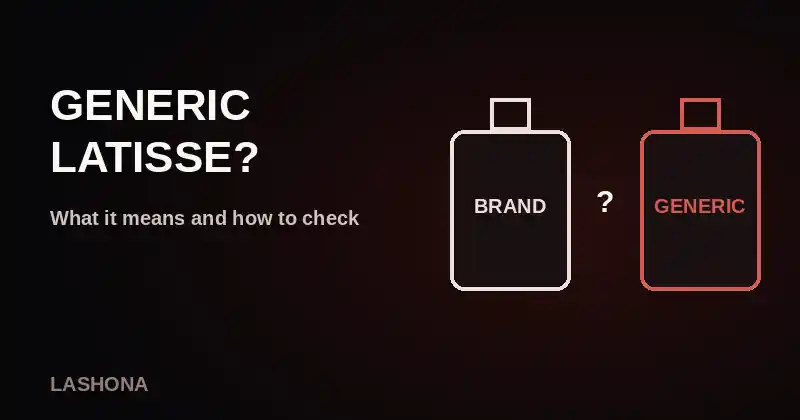
In the United States, “generic Latisse” has a real meaning: generic bimatoprost ophthalmic solution 0.03%, a prescription eyelash treatment approved by the FDA through its generic pathway. Sandoz launched an AT-rated generic version in December 2016, and Alembic announced FDA final approval for a therapeutically equivalent version in January 2020. The phrase is also used loosely online for products that are not FDA-approved generics at all, which is why it pays to know how to tell them apart.
This guide explains what the FDA means by a generic drug, which generics of Latisse have been approved, what a generic does and does not share with the brand, and how to check that a product labeled “generic Latisse” is what it claims to be. It is general information, not medical advice, and it describes US rules unless stated otherwise.
What Is Latisse?
Latisse (bimatoprost ophthalmic solution 0.03%) is a prescription product indicated to treat hypotrichosis of the eyelashes, meaning too few or too short lashes, by increasing their growth, including length, thickness, and darkness. The prescribing information describes it as an ophthalmic solution containing bimatoprost 0.3 mg/mL, applied to the base of the upper lashes using a sterile disposable applicator. According to the drug-approval history on Drugs.com, the FDA first approved it on December 24, 2008.
The same active ingredient is also used in a different product to lower raised pressure inside the eye. That glaucoma product is not the same thing, and it is not approved for eyelash growth. Our overview of bimatoprost for eyelashes explains the difference in detail.
What Does “Generic” Mean to the FDA?
The FDA’s definition is more specific than everyday usage. For a generic drug to be approved, the agency says it must:
- Contain the same active ingredient as the brand-name (innovator) drug.
- Be bioequivalent, meaning it delivers the active ingredient to the relevant site at essentially the same rate and extent.
- Be manufactured under the same quality standards that apply to the brand.
An FDA overview of generic drugs adds the other core requirements: the same strength, dosage form, route of administration, and conditions of use. A product that meets all of these and is bioequivalent is considered therapeutically equivalent, and the FDA publishes those determinations in a reference called the Orange Book. You can read the agency’s own summary in its explanation of what a generic drug is.
Two practical points follow. First, “generic” in this sense is a regulatory status that has to be earned through an application, not a marketing label that a seller can attach to any bottle. Second, generic approvals rely on showing equivalence to the brand product rather than repeating the full clinical trials, which is why the trial results in the Latisse label are the starting point for understanding what a generic is expected to do.
Generic Latisse in the US: What the Record Shows
Publicly available announcements and records give the following timeline:
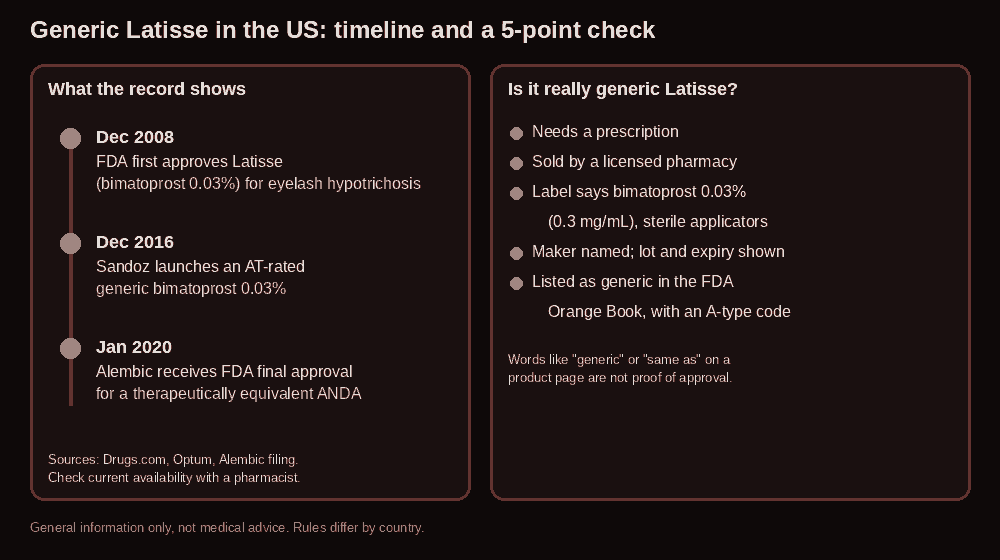
- December 2008: The FDA approves Latisse.
- December 2016: Sandoz announces the launch of its AT-rated generic version of Latisse, a 0.03% ophthalmic solution with the same indication, in the same strength as the brand. Industry coverage at the time described it as a prescription medicine.
- Later: Alembic Pharmaceuticals received tentative approval, and then, in January 2020, announced FDA final approval for its bimatoprost ophthalmic solution 0.03%. Its filing states that the approved application is therapeutically equivalent to the reference listed drug, Latisse.
These are historical facts about approvals and launches. They do not tell you which products are on pharmacy shelves today, who currently makes them, or whether a particular one is in stock. The FDA’s Orange Book and a licensed pharmacist are the right places to confirm that.
What an “AT” Rating Means
The Orange Book assigns therapeutic equivalence codes made of two letters. Codes beginning with A indicate that the FDA considers the generic therapeutically equivalent to the brand, and the AT code is the one used for topical products. Sandoz’s launch announcement described its product as AT-rated, which is shorthand for that status.
What a Generic Shares With the Brand, and What May Differ
| Likely the same | May differ |
|---|---|
| Active ingredient (bimatoprost) | Inactive ingredients |
| Strength (0.03%, or 0.3 mg/mL) | Bottle, applicator, and packaging design |
| Dosage form and route (ophthalmic solution, applied to the lash line) | Appearance and brand name |
| Approved use (eyelash hypotrichosis) | Manufacturer and price |
| Manufacturing quality standards | Pack sizes and supply arrangements |
The inactive ingredients are worth a look if you have sensitivities. The Latisse label lists the preservative benzalkonium chloride, which it says can be absorbed by soft contact lenses. If you have reacted to preservatives or other ingredients before, compare the full ingredient list on the product you receive with the one you used previously, and ask your pharmacist.
Does a Generic Carry the Same Risks?
Because a generic must have the same active ingredient and conditions of use, the safety information in the Latisse label is the right starting point for understanding the risks. It is still important to read the label that comes with the product you actually receive. The main points from the brand label include:
- Increased iris pigmentation has occurred, and the label says the brown pigmentation is likely to be permanent.
- Eyelid skin darkening and other changes around the eye have been reported, many of them reversible after stopping.
- Caution is advised with active eye inflammation, and people using prostaglandin analog eye drops for high eye pressure should consult their doctor before using the eyelash product.
- Contact lenses should be removed before application, with a 15-minute wait before reinserting them.
Our guide to bimatoprost side effects covers these in depth. The expected timeline is also the same kind of slow build: the brand trial showed a clear gain over placebo from about week 8, which we cover in how long bimatoprost takes to work.
Other Things People Mean by “Generic Latisse”
Search results for “generic Latisse” mix several quite different products. Sorting them out helps you avoid mistakes:
| Product type | What it is | FDA-approved eyelash treatment? |
|---|---|---|
| Brand Latisse | Prescription bimatoprost 0.03% from the originator | Yes |
| Generic bimatoprost 0.03% (ANDA) | Prescription copy approved through the FDA generic pathway | Yes, if it is an FDA-approved generic for eyelash hypotrichosis |
| Bimatoprost eye drops for eye pressure | A different product with different labeling, for glaucoma or ocular hypertension | Not for eyelashes, per its own labeling |
| Imported products with Latisse-like names | Approval and quality depend on the country of origin | Not unless the FDA has approved them |
| Cosmetic lash serums | Sold with cosmetic claims, often without a prescription | No. A cosmetic cannot be a generic of a drug |
Please note that a product page calling something “generic Latisse” or “same as Latisse” is not evidence of FDA approval. Our comparison of Latisse and Careprost explains why similar-sounding products should not be treated as interchangeable, and our article on prostaglandins in cosmetic lash serums covers what testing has found in non-prescription products.
How to Check a Generic Before You Use It
- Confirm it needs a prescription. The generic launched in the US was described as a prescription medicine. A seller offering a “generic Latisse” with no prescription is a warning sign.
- Use a licensed pharmacy. Pharmacists can confirm the product, the manufacturer, and whether it is the right strength and form.
- Read the label. It should say bimatoprost ophthalmic solution 0.03%, and the Latisse label describes 0.3 mg/mL with sterile single-use applicators. Check the manufacturer name, lot number, and expiry date.
- Look it up in the Orange Book. The FDA’s searchable database lists approved generics and their therapeutic equivalence codes. A bimatoprost 0.03% eyelash product with an A-type code is the kind of listing you want to see.
- Be skeptical of claims. Words such as “generic,” “same formula,” or “pharmacy grade” on a product page are not approvals. Ask the seller for the manufacturer’s name and verify it independently.
Getting It Through the Right Channel
Because it is a prescription drug, access goes through a licensed prescriber. That may be an eye-care professional, a dermatologist, or a primary care clinician, and some telehealth services offer consultations and send prescriptions to licensed pharmacies. A legitimate route will ask about your eye health and medications. It is worth raising the following with the prescriber:
- Any eye conditions, eye surgery, or eye-pressure medicines.
- Pregnancy, planning pregnancy, or breastfeeding.
- Contact lens use and any history of reactions to eye products.
- Your expectations, and whether you are willing to keep using it, since lashes are expected to return to their previous appearance after stopping.
Our article on prescription versus over-the-counter lash serums explains why the two categories differ.
Outside the United States
The generics discussed above were approved by the US FDA. Other countries, including the UK, Canada, Australia, Malaysia, Singapore, New Zealand, Hong Kong, and the Philippines, have their own regulators, approval records, brand names, and rules about whether eyelash products need a prescription. A product that is a generic in one country may be unapproved, classified differently, or unavailable in another, so the FDA status described here should not be assumed to apply elsewhere. Readers outside the US should check with their national medicines regulator or a local pharmacist.
What This Information Cannot Tell You
- What is on shelves today. Launch announcements describe moments in time.
- Whether a specific bottle is genuine. Only a licensed pharmacy and the manufacturer can confirm that.
- How well a generic will work for you. The efficacy figures in the Latisse label belong to the brand trial, and individual results vary.
- Anything about products in other countries. Rules differ widely.
Key Takeaways
- In the US, generic Latisse means FDA-approved generic bimatoprost ophthalmic solution 0.03%, available by prescription.
- The FDA requires a generic to share the active ingredient, strength, dosage form, and use, and to be bioequivalent to the brand.
- Sandoz launched an AT-rated generic in December 2016, and Alembic announced final FDA approval of a therapeutically equivalent generic in January 2020.
- “Generic” on a product page is not proof of approval, and cosmetic serums cannot be generics of a drug.
- The Latisse label’s risks, including likely permanent iris darkening, are the right reference point for a generic.
Frequently Asked Questions
Is there a generic version of Latisse?
Yes, in the United States. Sandoz announced an AT-rated generic bimatoprost 0.03% in December 2016, and Alembic announced FDA final approval for a therapeutically equivalent version in January 2020. Availability can change, so confirm with a pharmacy.
Is generic Latisse the same as Latisse?
The FDA requires the same active ingredient, strength, dosage form, route, and conditions of use, plus bioequivalence. Inactive ingredients and packaging may differ.
Do I need a prescription for generic Latisse?
Yes. The generic launched in the US was described as a prescription medicine, so be cautious of any seller offering it without one.
Is generic Latisse safe?
It carries the same kinds of risks as the brand, including eye itching and redness and permanent iris darkening in some people, so it should be used under professional guidance. Read the label supplied with your product.
Is Careprost a generic Latisse?
Not necessarily. A product that mentions the same ingredient is not automatically an FDA-approved generic. Approval, formulation, and labeling must be verified separately for each product.
Is the bimatoprost used for eye pressure the same as generic Latisse?
No. Bimatoprost eye drops for raised eye pressure are separate products with their own labeling, and they should not be used for eyelashes unless a doctor directs it.
Sources
- Latisse (bimatoprost ophthalmic solution) 0.03% prescribing information, AbbVie, revised July 2024.
- Drugs.com, Latisse FDA approval history.
- Optum Rx, “Latisse (bimatoprost) – First-Time Generic,” December 2016, and Chain Drug Review coverage of the Sandoz launch.
- Alembic Pharmaceuticals filing with BSE Limited, 23 January 2020, announcing FDA final approval of bimatoprost ophthalmic solution 0.03%.
- US Food and Drug Administration, “What is a Generic Drug?” (linked above).
Medical disclaimer: This article is for general information only and does not diagnose, treat, or give individual medical advice. Prescription eye treatments should be started, changed, or stopped only under the guidance of a qualified healthcare professional. Product availability and regulation differ between countries.