Eyelash Growth Serum: Cosmetic or Drug? What the FDA’s Intended-Use Rule Means
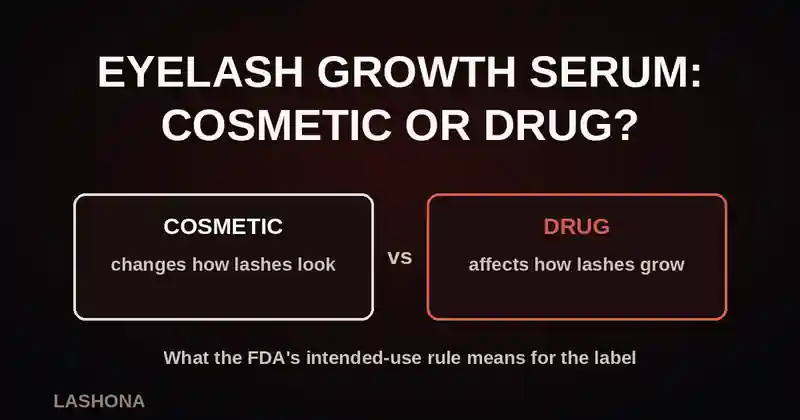
Whether an eyelash growth serum is a cosmetic or a drug is not decided by the bottle’s name or by a “cosmetic” sticker. In the United States it is decided by the product’s intended use. A serum sold to change how lashes look is a cosmetic. A serum sold to make lashes grow is making a claim the FDA treats as a drug claim, and drugs generally need FDA approval before they can be sold.
That distinction matters for anyone shopping for a lash serum, because it affects what evidence stands behind a product, what rules it must follow, and what a label can honestly tell you. This guide explains the FDA’s intended-use rule in plain language, shows how it applies to eyelash products, and gives a practical checklist for reading a label. It is general information, not legal or medical advice, and it describes US rules. Other countries differ.
How the FDA Defines a Cosmetic and a Drug
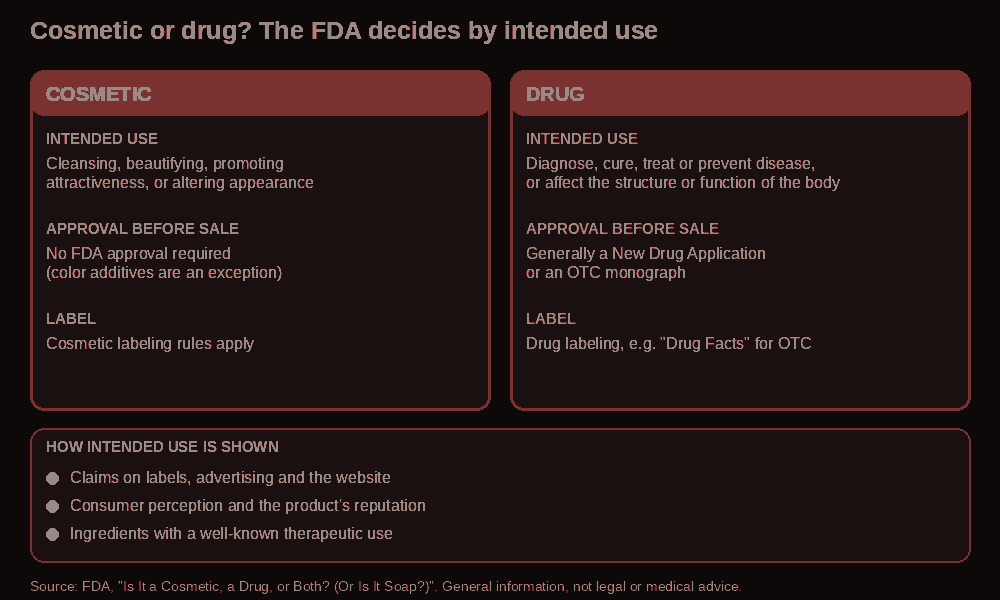
The Federal Food, Drug, and Cosmetic Act sets out two definitions that matter here, and the FDA summarizes them on its page about cosmetics, drugs, and products that are both.
- Cosmetics are articles intended to be rubbed, poured, sprinkled, or sprayed on, or otherwise applied to the body for cleansing, beautifying, promoting attractiveness, or altering the appearance. Moisturizers, perfumes, lipsticks, makeup, and hair colors are examples.
- Drugs are articles intended for use in the diagnosis, cure, mitigation, treatment, or prevention of disease, and articles other than food intended to affect the structure or any function of the body.
The second half of the drug definition is the important one for lash serums. A product that is intended to affect the structure of the body, such as making hair grow, falls on the drug side, even if it is applied like makeup and sold in a beauty aisle.
Some Products Are Both
The FDA notes that a product can meet both definitions when it has more than one intended use. Its own examples include an antidandruff shampoo, which cleanses hair (cosmetic) and treats dandruff (drug), and toothpaste with fluoride. Products like these must comply with the rules for both cosmetics and drugs.
“Cosmeceutical” Has No Legal Meaning
You will often see lash and skin products described as “cosmeceuticals” or “medical-grade.” The FDA is explicit that the law does not recognize any such category. A product can be a drug, a cosmetic, or both, but the term “cosmeceutical” has no meaning under the law. When you see it on a label or website, treat it as marketing language and look at the specific claims and ingredients instead.
How “Intended Use” Is Established
It would be convenient if a company could simply declare its product a cosmetic. It cannot. The FDA says intended use may be established in several ways, and these are the three most relevant to a lash serum:
- Claims. Statements on the label, in advertising, on the internet, or in other promotional materials. The FDA says certain claims can make a product a drug even when it is marketed like a cosmetic, and one of its examples is a claim that a product will restore hair growth.
- Consumer perception. This looks at the product’s reputation: why consumers buy it and what they expect it to do.
- Ingredients. An ingredient with a well-known therapeutic use can cause a product to be considered a drug. The FDA’s example is fluoride in toothpaste.
For eyelash products, the first and third are the most important. A serum promoted to grow lashes is making a growth claim. A serum that contains a prescription prostaglandin analog such as bimatoprost contains an ingredient with a well-known therapeutic use. Our explainer on bimatoprost for eyelashes covers what that ingredient is and why it is a prescription medicine.
What This Looks Like in the Eyelash Market
The eyelash category is a well-known example of the boundary in practice. In 2007 the FDA announced the seizure of an eyelash product called Age Intervention Eyelash. According to the agency, the product was promoted to increase eyelash growth and contained bimatoprost, so it was treated as an unapproved drug rather than a cosmetic. The agency also warned that using it could be hazardous for some people, including those already treated with the prescription version.
Legal commentary on a later dispute between the maker of Latisse and a lash-product company reports that a federal appeals court affirmed a finding that the defendant objectively intended its products to affect the structure of eyelashes, which made them drugs rather than cosmetics. Cases like these turn on the facts, so they should not be read as a rule that applies automatically to every product.
The takeaway for readers is simple. Growth language and prescription-drug ingredients are the two signals most likely to place a lash product on the drug side of the line. A product that sits there without drug approval deserves extra scrutiny.
What Cosmetic Status Does and Does Not Tell You
No Premarket Approval
Under the FD&C Act, cosmetic products and ingredients, with the exception of color additives, do not require FDA approval before they go on the market. That is a significant fact for a buyer. It means the FDA has not reviewed a cosmetic serum for whether it works before it is sold.
Drugs are different. They generally must either receive premarket approval through the New Drug Application process or conform to an over-the-counter monograph. The FDA says it approves an application only after determining that the data are adequate to show the drug’s safety and effectiveness for its proposed use and that its benefits outweigh the risks. That is the kind of evidence we describe in our look at how long bimatoprost takes to work, where the label’s trial data are laid out week by week.
Registration Is Not Approval
Under the Modernization of Cosmetics Regulation Act of 2022, cosmetic facility registration and product listing are now mandatory, with certain exemptions for small businesses. Those are record-keeping requirements. They do not mean the FDA has evaluated a product’s effectiveness. If a seller says a lash serum is “FDA registered” or “FDA listed,” that is not the same as “FDA approved.”
Cosmetic Does Not Mean Risk-Free
The absence of premarket approval does not mean cosmetics are unsafe, and it does not mean they are safe. It means a different system applies. Anything applied near the eye can irritate, and the label of a prescription product is a useful reminder of the kinds of reactions to watch for. Our guide to bimatoprost side effects lists what the prescribing information reports, and the same sensible caution applies to any product used close to the eyes.
Cosmetic-Type Claims and Drug-Type Claims
The FDA decides intended use case by case, so no list of words can guarantee how a product will be classified. As a reading aid, the table below shows the kinds of wording that tend to describe appearance versus structure or function. It is illustrative, not an FDA ruling.
| Wording that describes appearance | Wording that describes structure or function |
|---|---|
| Makes lashes look longer or fuller | Grows lashes, restores lash growth |
| Conditions and moisturizes lashes | Stimulates follicles or lengthens the growth phase |
| Enhances the look of lashes | Treats thinning, hypotrichosis, or lash loss |
The FDA’s own example is a claim to restore hair growth, which it lists among claims that establish a product as a drug. A serum that does more than describe appearance should be able to point to the approval or evidence that supports that stronger claim.
A Practical Label-Reading Checklist
You cannot verify a company’s internal intent, but you can read what is in front of you. These checks take a few minutes and apply to any lash serum, wherever you buy it.
- Read the front-of-pack claim. Is it about how lashes look, or about growing and restoring them?
- Find the full ingredient list. Cosmetics sold for personal use should list their ingredients. A missing or vague list is a warning sign. Our guide to lash serum ingredients explains how to read one.
- Look for a “Drug Facts” panel. The FDA says over-the-counter drugs are labeled under drug regulations, including Drug Facts, and that combination products list drug ingredients as active ingredients first. A real drug product will look different from a cosmetic.
- Check for prescription ingredients. If an ingredient list names a prescription prostaglandin analog such as bimatoprost on a product sold without a prescription, treat that as a red flag and do not assume the product matches a prescription formulation.
- Be skeptical of equivalence claims. Phrases that imply a product is a “generic” or “same as” a prescription brand need verification against official sources. Our comparison of Latisse and Careprost explains why similar-sounding products are not necessarily interchangeable.
- Look at who is selling it. A seller should be identifiable and contactable, and product pages should not rely on testimonials as proof of effectiveness.
- Compare timelines to the evidence. If a claim promises dramatic results in days, compare it with what the best-documented prescription trial data actually show.
If your lashes are thinning, a product label is not a substitute for an assessment. Sudden loss, patchy loss, or loss that also affects the eyebrows is worth discussing with a clinician before you try more products.
Rules Differ Outside the United States
Everything above describes US law. Regulators in the UK, Canada, Australia, Malaysia, Singapore, New Zealand, Hong Kong, the Philippines, and elsewhere have their own definitions, approval systems, and labeling rules, and a product can be classified differently from one country to the next. If you are buying outside the United States, check your national medicines or cosmetics regulator, or ask a local pharmacist or eye doctor, rather than assuming FDA rules apply.
Key Takeaways
- In the US, intended use, not a label’s wording, decides whether a product is a cosmetic or a drug.
- Claims, consumer perception, and ingredients all feed into that decision.
- Claims about restoring hair growth are drug claims, and “cosmeceutical” has no legal meaning.
- Cosmetics do not need FDA approval before sale, so cosmetic status says nothing about whether a serum works.
- “FDA registered” is not “FDA approved.”
- A short label check, covering claims, ingredients, labeling format, and seller, will tell you a lot.
Frequently Asked Questions
Is eyelash growth serum FDA approved?
Cosmetic serums are not approved by the FDA, because cosmetics do not go through premarket approval. The prescription product Latisse (bimatoprost 0.03%) is FDA-approved to treat hypotrichosis of the eyelashes.
Can a cosmetic serum legally claim to grow eyelashes?
The FDA lists claims to restore hair growth among claims that establish a product as a drug. A product that makes growth claims is therefore generally treated as a drug, which needs approval, unless it is marketed only with appearance claims.
Does “FDA registered” mean the product works?
No. Registration and listing are mandatory record-keeping requirements for cosmetic facilities and products, with some small-business exemptions. They are not an approval or an evaluation of effectiveness.
Is a “cosmeceutical” lash serum stronger than a cosmetic?
The term has no meaning under US law, so it tells you nothing about strength. Look at the ingredient list and the specific claims instead.
Why does it matter if a serum contains bimatoprost?
Bimatoprost is a prescription drug ingredient. The FDA has treated lash products containing it as unapproved drugs in the past, and combining products can carry risks. Anyone using prescription eye treatments should check with their doctor before adding a lash product.
Do these rules apply in other countries?
No. This guide describes US rules. Other regulators define and classify these products differently, so check with your local authority.
Source
Disclaimer: This article is for general information only and is not legal or medical advice. Regulatory classification depends on the facts of each product and the rules of each country. Prescription eye treatments should be started, changed, or stopped only under the guidance of a qualified healthcare professional.