Do Eyelash Growth Serums Contain Prostaglandins? What Studies and Regulators Found
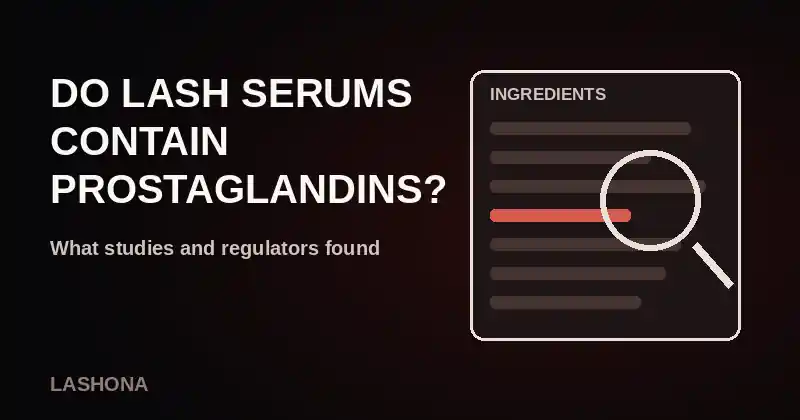
Some eyelash growth serums do contain prostaglandin analogs, and some of them do not say so on the label. Laboratory testing of serums bought online in Japan found bimatoprost in 4 of 64 products, and three of those four did not list it. A 2026 review of 79 cosmetic serums promising longer, thicker lashes found that roughly 30% contained a prostaglandin analog.
That matters because prostaglandin analogs are pharmacologically active drug ingredients, and regulators in several regions treat them very differently from ordinary cosmetic ingredients. This guide explains what the studies found, what regulators have said, which ingredient names to watch for, and what the evidence cannot tell you. It is general information and not medical advice.
Why Prostaglandin Analogs Show Up in Lash Serums
Prostaglandin analogs are a class of eye medicines first used to lower raised pressure inside the eye. People using them noticed that their lashes grew longer and darker. The label for the prescription eyelash product (Latisse, bimatoprost 0.03%) explains the current understanding: eyelash growth is believed to occur by increasing the percentage of hairs in the growth phase and the duration of that phase, although the precise mechanism is unknown.
That observation made this drug class attractive to makers of lash products. A serum that contains one can plausibly produce visible effects, which is exactly why it is also the kind of ingredient that regulators want declared, assessed, and controlled. If you want background on how lashes grow, our overview of what eyelash growth serum is and how it works covers the basics.
What Testing Has Found
Online Serums Bought in Japan
A study in the Journal of Pharmaceutical and Biomedical Analysis developed a laboratory method (LC-MS/MS) to detect 14 prostaglandin F analogs in cosmetic serums. Researchers purchased 64 eyelash serums from 34 websites and tested them. The reported results were:
- 4 of the 64 products contained bimatoprost.
- 3 of those 4 did not state it on the package label.
- None of the samples contained latanoprost, travoprost, or tafluprost, which are used to treat glaucoma.
- 8 products contained other prostaglandin F analogs that are not used as pharmaceuticals.
The authors concluded that easy online access to serums containing these compounds creates a risk of serious side effects, particularly when consumers are not told what the products contain.
Cosmetic Serums Promising Longer Lashes in France
A qualitative study published online in June 2026 by French researchers examined 79 cosmetic products that promised longer, thicker, or fuller eyelashes. The serums were mainly hydroalcoholic solutions. About 30% contained a prostaglandin analog, and six different analogs were found, including bimatoprost and norbimatoprost. The authors noted that such serums are marketed as eyelash growth treatments even though prostaglandin analogs are not regulated for use in cosmetic products.

How to Read These Numbers
Both studies are snapshots, and neither describes every product on every market. The Japanese samples came from online sellers in one country at one point in time, and the French work was a qualitative review of products chosen because they promised lash growth. The percentages should not be read as the share of all lash serums worldwide. What the studies do show is that prostaglandin analogs in cosmetic lash products are a documented reality, and that the label alone may not reveal them.
Names to Look For on an Ingredient List
Prostaglandin analogs often appear under long chemical names, which is one reason shoppers miss them. The following names have appeared in regulatory documents and published reports about lash and brow serums:
- Bimatoprost
- Norbimatoprost
- Isopropyl cloprostenate
- Dechloro dihydroxy difluoro ethylcloprostenolamide, which regulators also discuss under the name ethyl tafluprostamide
- Methylamido dihydro noralfaprostal
- Dehydrolatanoprost, which a New Zealand consumer investigation listed under the longer chemical name isopropyl phenylhydroxypentene dihydroxycyclopentylheptenate
This is not a complete list, and the absence of these names does not prove a product is free of them. The Japanese study found bimatoprost in serums that did not list it. Our guide to lash serum ingredients explains how to read the rest of a label.
What Regulators Have Said
The European Union
The EU’s Scientific Committee on Consumer Safety (SCCS) has examined this class of ingredients twice. In its 2022 opinion, it noted that prostaglandins and their synthetic analogs are well known to be potent pharmacologically active substances, that other regulatory authorities have advised against or prohibited their use in eyelash growth cosmetics, and that they can cause effects at very low concentrations in a product intended for use near the eye. The committee raised safety concerns. You can read the opinion on the European Commission’s health website.
A follow-up assessment went further. A preliminary opinion published in 2025 concluded that three analogs it reviewed (isopropyl cloprostenate, norbimatoprost, and dechloro dihydroxy difluoro ethylcloprostenolamide) could not be considered safe for cosmetics intended to promote eyelash and eyebrow growth. Trade reports say the final opinion, issued on 10 February 2026, reaffirmed this, citing strong pharmacological activity, insufficient data to exclude reproductive or developmental toxicity, and the inability to rule out non-genotoxic carcinogenicity without relevant studies. As of those reports, these ingredients were not yet formally restricted under the EU Cosmetics Regulation, and the opinions were expected to inform possible changes to the rules.
New Zealand, Australia, and Canada
Rules differ widely. A Consumer NZ investigation reported that in New Zealand, prostaglandins are prescription medicines but products with very low levels (10 mg per liter or less) were exempt and could be sold without a prescription. It also reported that products containing prostaglandins and advertised with a therapeutic purpose are treated as medicines under the Medicines Act, and that Medsafe wrote to one distributor in 2019 about its therapeutic claims. The same article said Australia and Canada do not allow prostaglandin-containing lash serums to be sold without a prescription.
That investigation is not dated on the page and describes a then-recent European review, so rules may have changed since it was written. Readers in these markets should confirm the current position with their national regulator.
The United States
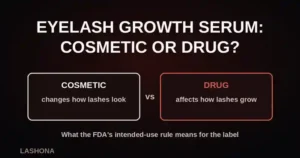
In the United States, the FDA-approved eyelash product containing bimatoprost is a prescription medicine, and the FDA has previously treated a non-prescription eyelash product containing bimatoprost as an unapproved drug. Our article on prescription versus over-the-counter lash serums explains how intended use affects whether a product is a drug or a cosmetic.
Why It Matters for Your Eyes
Prostaglandin analogs are not mild ingredients. The prescribing information for bimatoprost, the best-documented example, says increased iris pigmentation has occurred and is likely to be permanent. It also lists eyelid and periocular skin darkening that is reported to be reversible in most patients, and, from postapproval reports, changes such as a deepened eyelid crease and drooping eyelid. Our overview of lash serum side effects covers reactions to lash products more broadly.
For the other analogs, the situation is arguably less reassuring, not more. The SCCS did not say they are safe; it said the available data were insufficient to show that they are. A prescription product comes with a label, a prescriber, and monitoring. A cosmetic serum that contains an unlisted analog offers none of these.
A 2018 German risk assessment, as reported by Consumer NZ, found no evidence of a dose at which lash growth can be enhanced without adverse effects. The same report cited a 2020 survey of 154 consumers who had tried over-the-counter serums, in which 44% had stopped using them, most often because of side effects. Anyone with an allergic reaction should also see our guide to allergic reactions to lash serum.
Who Should Be Especially Careful
- People using eye-pressure medicine. The bimatoprost label says exposure to more than one dose of bimatoprost daily may reduce the pressure-lowering effect, and that people using prostaglandin analog drops should only use the eyelash product after consulting a physician.
- Pregnant or breastfeeding people. The label says there are no adequate studies in pregnant women and advises use only if the benefit justifies the risk. The SCCS also cited insufficient data to exclude reproductive or developmental toxicity for the analogs it reviewed.
- People undergoing chemotherapy. An optometry researcher quoted by Consumer NZ cautioned that these serums can cause inflammation, which may worsen dryness that chemotherapy already causes.
- Anyone with eye disease or recent eye surgery. The label advises caution with active eye inflammation and recommends medical advice before use after eye surgery.
How to Check a Serum Before You Use It
- Read the full ingredient list and compare it with the names above. Treat an incomplete or missing list as a warning sign.
- Look at the claims. A product that promises dramatic lash growth within weeks is making a drug-style claim. The trial for the prescription product showed a clear gain over placebo only from about week 8, which our article on how long bimatoprost takes to work explains.
- Check for warnings. Consumer NZ reported that some products it examined carried no warnings on the pack, with risk information only in small print on a leaflet inside the sealed box.
- Verify the seller and the regulatory status in your country, especially for products bought from marketplaces or websites without clear company details.
- Ask a professional. A pharmacist or eye-care professional can look at the label and your medical history.
This applies to any product you are considering, including those sold on this site. Check the label and your local regulatory status for each one.
What About Serums Without Prostaglandin Analogs?
A serum that does not contain a prostaglandin analog is not automatically risk-free, because any product used near the eyes can irritate or trigger an allergy. It is also less likely to produce the kind of dramatic effect that prostaglandin analogs can. In the sources used for this article, we did not find controlled-trial data for non-prostaglandin cosmetic serums comparable to the label data for bimatoprost, so we cannot say how well they work. Expectations should be modest, and claims of guaranteed growth should be treated with caution.
What This Evidence Cannot Tell You
- It cannot tell you what is in your product. Only testing of that specific batch can.
- It does not describe every market. The studies cover online products in Japan and a set of products reviewed in France.
- It is not a ranking of safe and unsafe brands. We do not name products, and we have not tested any.
- Regulations change. The EU opinions were described as informing possible rule changes, and national positions may have moved since the sources cited here were published.
Key Takeaways
- Testing has found bimatoprost and other prostaglandin analogs in cosmetic lash serums, including products that did not list them.
- The EU’s scientific committee has concluded that several of these analogs cannot be considered safe in cosmetics for lash and brow growth.
- Rules differ by country, and a product legal to sell in one place may be a prescription medicine in another.
- Bimatoprost’s own label says iris darkening is likely to be permanent, and the other analogs have less safety data.
- A label check helps, but cannot guarantee a product is free of an analog.
Frequently Asked Questions
Do eyelash growth serums contain prostaglandins?
Some do. A study of 64 serums bought online in Japan found bimatoprost in four, and a 2026 review of 79 cosmetic serums found about 30% contained a prostaglandin analog. Many other serums do not contain them, so it depends on the product.
Is bimatoprost allowed in cosmetic lash serums?
It depends on the country. In the United States, the FDA-approved bimatoprost eyelash product is a prescription medicine, and the agency has treated an over-the-counter bimatoprost lash product as an unapproved drug. Check your national regulator for the current position.
How can I tell if a serum contains a prostaglandin analog?
Compare the ingredient list with the names above. However, a study found bimatoprost in serums that did not list it, so a clean-looking label is not proof.
Are prostaglandin-free serums safe for everyone?
No. Any eye-area product can cause irritation or an allergic reaction, so stop using it and seek advice if you develop swelling, intense itching, pain, or vision changes.
Are the effects of prostaglandin analogs permanent?
For bimatoprost, the label says eyelid skin darkening is reported to be reversible in most patients, but increased iris pigmentation is likely permanent. For the other analogs, regulators have said the safety data are insufficient.
What should I do if I think my serum contains one?
Talk to a pharmacist or eye-care professional, especially if you use eye-pressure medicine, are pregnant or breastfeeding, or notice any eye symptoms. Do not change a prescribed treatment without speaking to your prescriber.
Sources
- Screening and quantification of undeclared PGF2α analogs in eyelash-enhancing cosmetic serums using LC-MS/MS, Journal of Pharmaceutical and Biomedical Analysis.
- Couteau C, Coiffard L. Prostaglandin analogues in cosmetic products formulated for eyelash lengthening, published online June 2026 (DOI 10.1016/j.pharma.2026.06.007).
- Scientific Committee on Consumer Safety (SCCS), opinions on prostaglandins and prostaglandin analogs in cosmetic products (2022; preliminary 2025; final reported February 2026).
- Consumer NZ, “Eyelash serums: the downside of longer lashes.”
- Latisse (bimatoprost ophthalmic solution) 0.03% prescribing information, AbbVie, revised July 2024.
Medical disclaimer: This article is for general information only and does not diagnose, treat, or give individual medical advice. Prescription eye treatments should be started, changed, or stopped only under the guidance of a qualified healthcare professional. Product availability and regulation differ between countries.