How Long Does Bimatoprost Take to Work on Eyelashes? What the Trial Data Shows
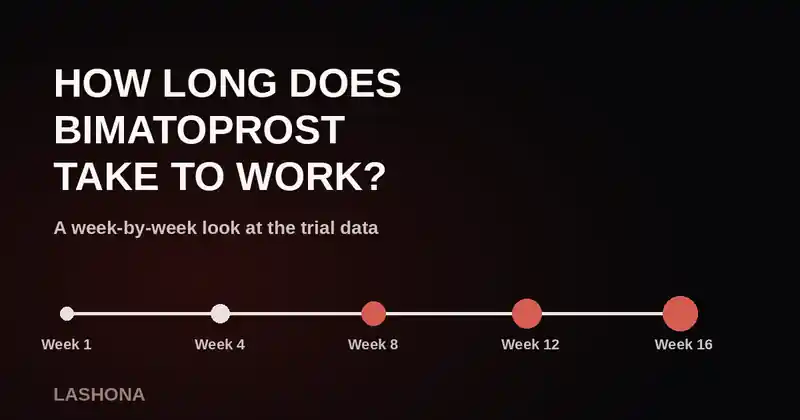
In the main clinical trial for prescription bimatoprost eyelash solution (Latisse), a statistically significant gain over placebo appeared by week 8, and results were highest around week 16. The label itself says the effect is gradual and not significant in most patients until about two months. Results did not appear overnight: at week 1, only 5% of treated participants showed improvement, compared with 2% on the placebo-like vehicle.
This guide walks through the trial timeline week by week, explains what the measurements actually mean, and describes what happens when treatment stops. Every number comes from the US prescribing information for Latisse (bimatoprost ophthalmic solution 0.03%), revised in July 2024. It is general information, not medical advice, and individual results vary.
The Short Answer: A Realistic Timeline
Based on the label, here is what the trial data supports:
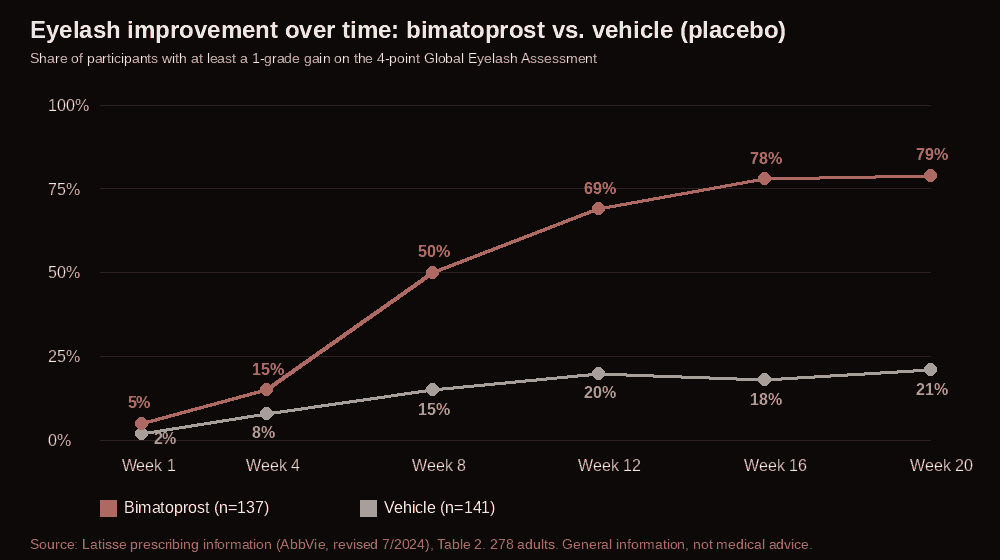
- Weeks 1 to 4: Little difference from placebo. The share of treated participants with improvement was 5% at week 1 and 15% at week 4, against 2% and 8% for the vehicle.
- Week 8: The turning point. Half of treated participants (50%) showed improvement, against 15% on vehicle, and the label reports a statistically significant difference from this point.
- Weeks 12 to 16: Continued gains, reaching 69% at week 12 and 78% at week 16, the primary endpoint of the study.
- After week 16: The week 20 reading was 79%, essentially level with week 16.
The patient information puts it simply for readers: fifty percent of patients in a clinical study saw significant improvement by two months after starting treatment.
How the Trial Was Designed
Understanding the design helps you read the numbers correctly. The label describes a multicenter, double-masked, randomized, vehicle-controlled, parallel-group study of 278 adults treated for four months. Participants were randomly assigned to either bimatoprost (137 people) or the vehicle (141 people), which is the same solution without the active ingredient.
Three design features matter for interpreting results:
- Double-masked. Neither participants nor assessors were supposed to know who received which solution, which reduces bias in how lashes were rated.
- Vehicle-controlled. Comparing against the vehicle separates the effect of bimatoprost from everything else that can change how lashes look over four months.
- Adults only in this trial. The label also describes a separate 16-week study in children and adolescents, covered below, but the main timeline comes from adults.
The Week-by-Week Data
The primary endpoint was an increase in overall eyelash prominence, measured as at least a 1-grade improvement on the 4-point Global Eyelash Assessment (GEA) scale, from baseline to week 16. The chart below plots the results from the label at each time point.
| Week | Bimatoprost | Vehicle | Gap (percentage points) |
|---|---|---|---|
| 1 | 7 of 137 (5%) | 3 of 141 (2%) | 3 |
| 4 | 20 of 137 (15%) | 11 of 141 (8%) | 7 |
| 8 | 69 of 137 (50%) | 21 of 141 (15%) | 35 |
| 12 | 95 of 137 (69%) | 28 of 141 (20%) | 49 |
| 16 | 107 of 137 (78%) | 26 of 141 (18%) | 60 |
| 20 | 103 of 137 (79%) | 27 of 141 (21%) | 58 |
The gap column is our own subtraction of the label’s percentages. The label states that LATISSE was more effective than the vehicle, with statistically significant differences seen at the 8-week, 12-week, and 16-week time points. It does not claim significance for the earlier readings, which is consistent with the small early gaps.
Why Some Vehicle Users Improved Too
Roughly one in five vehicle users (18% at week 16) also showed a 1-grade improvement. That is a useful reminder that lash appearance changes for reasons unrelated to the active ingredient, and that rating scales have some inherent variability. It is also why a trial with a comparison group is more informative than before-and-after photos from a single user, which cannot separate the product from natural variation.
The Plateau After Week 16
The week 20 figure (79%) is barely above week 16 (78%). The label’s table does not explain this reading in detail, and it separately notes that after the 16-week treatment period, a 4-week post-treatment period followed during which the effects of bimatoprost started to return toward baseline. A cautious reading is that the data show no meaningful gain beyond week 16, and that the label expects the effect to fade after treatment stops. We would not read more into the week 20 number than that.
What Improved: Length, Thickness, and Darkness
The GEA is a rating scale. The same study also measured lashes using digital image analysis, which gives more concrete numbers. At week 16, the mean change from baseline was:
| Measure | Bimatoprost | Vehicle |
|---|---|---|
| Eyelash length | 1.4 mm (25% increase) | 0.1 mm (2% increase) |
| Thickness (area) | 0.7 mm² (106% increase) | 0.1 mm² (12% increase) |
| Darkness (intensity) | 18% darker | 3% darker |
Two details help put these in context. First, the label reports that improvements in length, fullness or thickness, and darkness were statistically significantly more pronounced in the bimatoprost group at weeks 8, 12, and 16, the same timeline as the rating scale. Second, in the darkness measurement a negative value represents darkening, so the label’s figures of minus 20.2 for bimatoprost and minus 3.6 for vehicle point in the direction of darker lashes.
A 1.4 mm average length gain is a modest absolute change, even though it is a meaningful 25% relative increase. Averages also hide individual variation: some participants gained more and some less.
Why It Takes Weeks Rather Than Days
Eyelashes grow in cycles. Each lash has a growing phase, a short transition phase, and a resting phase before it sheds, and different lashes are at different stages at any time. Our guide to the eyelash growth cycle explains the stages in more detail.
The label’s own explanation of how bimatoprost works is that the precise mechanism is unknown, but eyelash growth is believed to occur by increasing the percentage of hairs in the growth (anagen) phase and the duration of that phase. If that explanation is right, it fits the timeline: lengthening the growing phase and moving more follicles into it takes time to show up as visibly longer, thicker lashes, rather than producing instant changes.
This also gives you a reasonable way to judge claims you may see online. A trial of the prescription product found only a 3-percentage-point gap over the vehicle at week 1. Any product promising dramatic visible results within days or a couple of weeks is promising something faster than the best-documented prescription data shows, and should be viewed with caution.
Practical Points From the Label
The label gives several instructions that relate directly to results. These are summarized for general information and are not a substitute for the instructions that come with your prescription.
- It is a nightly treatment. The label directs one application nightly to the upper eyelid margin at the base of the lashes, using the supplied sterile applicators.
- More is not better. The label states that additional applications will not increase the growth of eyelashes.
- Missed doses. The patient information says not to try to catch up and to apply the next evening.
- Patience is expected. The onset of effect is described as gradual and not significant in most patients until about two months.
While you wait for results, it is also worth knowing the common effects reported in the trial, such as eye itching and redness, each in roughly 3% to 4% of participants. Our overview of lash serum side effects covers reactions to lash products in general.
What Happens After You Stop
The label says that upon discontinuation, eyelash growth is expected to return to its pre-treatment level. The patient information adds that lashes are expected to return to their previous appearance over several weeks to months, and that eyelid skin darkening is expected to reverse over a similar period. The effect on lash growth is expected to fade further following longer-term discontinuation.
In other words, the timeline works in both directions: gains build over about two to four months of consistent use and fade over weeks to months after use ends. People who are not prepared to continue treatment should know this before starting. Anyone considering stopping a prescribed treatment should talk with their prescriber.
Is the Timeline Different for Children and Adolescents?
The label includes a separate 16-week, vehicle-controlled study in pediatric patients who were post-chemotherapy or had alopecia areata, and adolescents who had hypotrichosis with no associated medical condition. No new safety issues were observed.
The results, measured as a 1-grade improvement on the GEA at month 4, varied a lot by group, and all of these groups were small:
- Adolescents with hypotrichosis (ages 15 to 17): 19 of 26 (73%) on bimatoprost versus 1 of 14 (7%) on vehicle.
- Post-chemotherapy pediatric patients (ages 5 to 17): 11 of 13 (85%) versus 3 of 3 on vehicle.
- Alopecia areata pediatric patients (ages 5 to 17): 4 of 9 (44%) versus 2 of 6 (33%).
The small group sizes mean these numbers should not be generalized. The takeaway is that results were not uniform across groups, and any decision about younger people belongs with a clinician.
What the Trial Cannot Tell You
- Your individual result. Averages and percentages describe groups, not any one person.
- Anything past about five months. The main study ran 16 weeks of treatment plus a short follow-up, so longer-term effects on lash appearance are not described in these tables.
- Other products. These numbers belong to one specific prescription formulation. A cosmetic serum or a different product that mentions the same ingredient has not been shown by this label to behave the same way. Our guide to prescription versus over-the-counter lash serums explains why, and our comparison of Latisse and Careprost covers why similar-sounding products should not be assumed equivalent.
- Safety trade-offs. A good result on the rating scale says nothing about risks such as iris pigmentation, which the label says is likely to be permanent. Anyone weighing the decision should consider both sides with a clinician.
Key Takeaways
- In the main trial, a statistically significant gain over vehicle first appeared at week 8, and results were highest around week 16.
- Half of treated participants showed improvement at week 8 and 78% at week 16, compared with 15% and 18% on the vehicle.
- Average length rose 1.4 mm (25%) at week 16, with significant improvements in thickness and darkness as well.
- Using more product, or using it more often, is not described as increasing growth.
- After stopping, lashes are expected to return to their previous appearance over several weeks to months.
Frequently Asked Questions
How long does bimatoprost take to grow eyelashes?
In the main trial, a clear gain over placebo appeared by week 8, and results were highest around week 16. The label describes the onset as gradual and not significant in most patients until about two months.
Can you see results in two weeks?
The trial data do not support that. At week 1, 5% of treated participants showed improvement versus 2% on vehicle, and at week 4 the figures were 15% versus 8%. The label does not report significant differences that early.
Do results keep improving after 16 weeks?
The label’s week 20 reading (79%) was nearly identical to week 16 (78%), so the data do not show further gains beyond week 16.
Will my lashes stay longer if I use more of it?
No. The label states that additional applications will not increase the growth of eyelashes, and that using it more than once a day will not do more than once-daily use.
What happens when I stop using it?
Eyelash growth is expected to return to its pre-treatment level, with lashes returning to their previous appearance over several weeks to months.
Do cosmetic lash serums follow the same timeline?
Not necessarily. This timeline comes from one prescription product’s trial. Cosmetic serums have different ingredients and different evidence, so these results should not be assumed to apply to them.
Source
Medical disclaimer: This article is for general information only and does not diagnose, treat, or give individual medical advice. Prescription eye treatments should be started, changed, or stopped only under the guidance of a qualified healthcare professional. Product availability and regulation differ between countries.