Is It Bad to Sleep in Mascara? What Eye-Health Sources Say and What to Do the Morning After
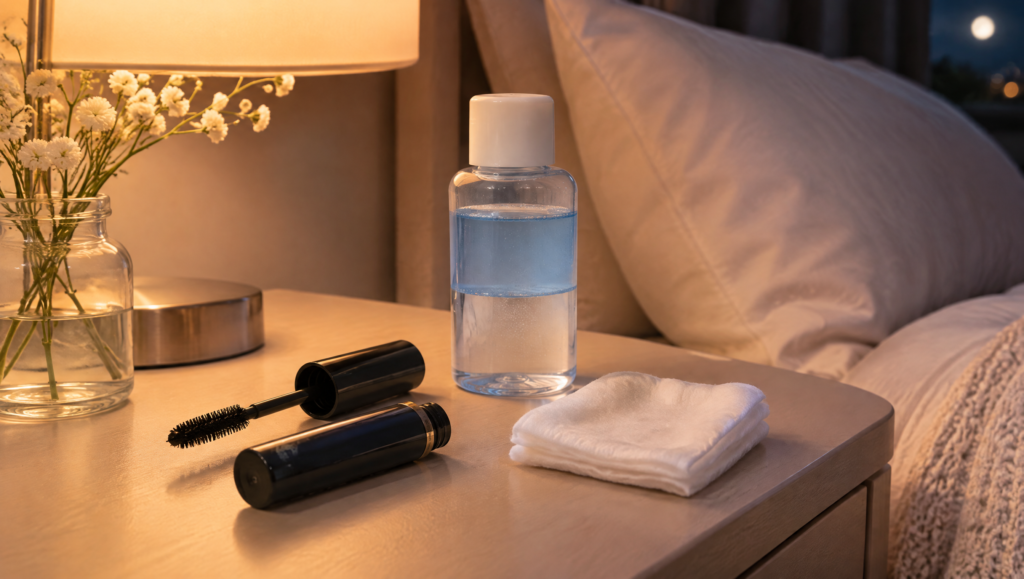
You get home late, the pillow looks irresistible, and the mascara stays on. Almost everyone has done it at least once, and most people wake up with smudged lashes and nothing worse. Even so, eye-health organizations are unusually consistent on one point: eye makeup should come off every night.
This guide explains why the advice is so firm, what the documented risks are (including one rare and extreme case report), and what a one-off slip most likely means. It also gives a gentle morning-after routine, notes for contact lens wearers and lash extension wearers, and the signs that mean it is time to see an eye doctor.
Nothing here replaces an eye exam. If your eyes hurt, change color, or affect your vision, a licensed clinician is the right person to ask, not an article.
Key Takeaways
- Eye-health groups, including the American Academy of Ophthalmology and Prevent Blindness, say to remove eye makeup every night, with mascara singled out because it clings to the lashes.
- The usual problems reported are irritation, a gritty feeling, redness and eyelid bumps. Infection is the more serious concern.
- A well-known 2018 case report described mascara particles embedded under the eyelids after about 25 years of heavy use and poor removal. Clinicians describe it as rare and extreme.
- One night in mascara is generally described as unlikely to cause lasting harm. The risk grows when it becomes a habit.
- After a slip, cleanse gently, skip rubbing, and give your eyes a makeup-free day if they feel irritated.
- Replace mascara about every three months and throw it out after any eye infection.
- Persistent pain, discharge, light sensitivity or vision changes call for a prompt eye exam.
Why do eye-health groups say never to sleep in eye makeup?
The American Academy of Ophthalmology tells people to remove all eye makeup at night, especially mascara that sticks to the lashes, and the FDA’s eye cosmetic safety guidance notes that in rare cases people have been temporarily or permanently blinded by an infection from an eye cosmetic. Prevent Blindness is blunter in its fact sheet: always remove makeup every night, and never sleep with eye makeup on.
The reasoning comes down to location and time. Mascara and eyeliner sit right at the lid margin, next to the tear film, the oil glands and the surface of the eye. During the day you blink thousands of times, which keeps flakes and debris moving. At night your lids are closed for hours, so whatever is on the lashes has nothing to do but sit against the lid, shift when you turn over, and rub on the pillow.
Mascara is also a product that bacteria can colonize. Eye-health groups advise throwing it away after about three months because a moist tube opened and closed daily is a friendly home for microbes. Leaving it on overnight adds many more hours of contact between that product and your lids. If you want the full reasoning on replacement timing, our guide on when to replace mascara covers it in detail.
What can happen to your eyes if you sleep in mascara?
Most of the reported problems are mild and temporary, but they sit on a spectrum. Here is how clinicians and eye-health groups describe it.
Irritation, redness and a gritty feeling
The most common result is simply an unhappy eye: a scratchy or sandy sensation, watering, redness and puffy lids on waking. Flakes of mascara can drift into the eye overnight, and Prevent Blindness notes that fibers in some eye makeup can flake off and scratch. This usually settles once the eyes are cleaned and left alone, though a regular habit keeps the irritation going. If your eyes already feel dry, see our notes on lash products and dry eye.
Clogged oil glands and eyelid bumps
The edge of each lid contains tiny oil glands that help keep the tear film stable. An eye-care professional quoted by Global News described makeup at the lid edge as something that can block those openings. Sutter Health’s ophthalmology team makes a related observation: a clinician there says infections are seen more often in people who do not remove eye makeup every night. A blocked or inflamed gland can show up as a tender lump, and our explainer on telling a stye or chalazion apart shows how those bumps differ.
Eye and eyelid infection
Bacteria from the lid margin, from a contaminated applicator, or from your hands can reach the eye. Conjunctivitis, commonly called pink eye, is one example, and if you have had an infection, eye-health groups say to throw away the makeup you used. Cases of serious corneal infection tied to cosmetics are uncommon, but they are the reason the advice is phrased so strongly.
The rare long-term buildup case
A frequently cited 2018 case report in the journal Ophthalmology, by ophthalmologist Dana Robaei, described a 50-year-old woman with a chronic foreign-body sensation in both eyes. Under her upper lids the doctor found dark, hard deposits that had built up from mascara particles after about 25 years of heavy use and inadequate removal. Reports on the case describe inflammation of the conjunctiva, small corneal scratches and permanent scarring, and the deposits needed surgical removal.
It is important to keep this in proportion. The report itself and the clinicians commenting on it describe it as an extreme, rare case, not a typical outcome. Its value is as a picture of what years of poor removal can look like, not as a prediction for someone who occasionally falls asleep with makeup on.
Is one night of sleeping in mascara actually dangerous?
For most people, a single night is unlikely to cause lasting harm. Dermatologists and surgeons quoted in consumer health media describe an occasional slip as a small risk, while stressing that a regular habit raises the chance of chronic irritation and infection. In other words, one forgotten night calls for a good cleanse in the morning, not for alarm.
The picture changes if you wake up with symptoms. Pain, a feeling that something is stuck in the eye, discharge, marked redness, or sensitivity to light are not normal makeup aftereffects, and they deserve a prompt eye exam rather than waiting it out.
What should you do the morning after?
Think “gentle and thorough.” The aim is to clear the leftover product without adding friction to eyes that may already be sensitive.
- Wash your hands first. Bacteria on fingers are an easy route to the eye.
- If you wear contact lenses, take them out before removing makeup, and leave them out until your eyes feel normal.
- Use a gentle eye makeup remover on a clean cotton pad, rest it on the closed lid for a few seconds, and wipe softly toward the outer corner instead of scrubbing.
- Clear the base of the lashes. The American Academy of Ophthalmology suggests brushing a clean cotton swab along the lash base to lift remaining traces, and rinsing the remover off your lids thoroughly afterward.
- Keep remover out of the eye itself. If some gets in, rinse with clean water.
- Give your eyes a makeup-free day if they feel scratchy or look red.
- Check the tube. If your eyes become infected, eye-health groups say to throw away the mascara and liner you were using.
How do you remove mascara properly at night?
A good routine takes about two minutes and prevents the whole question. These points come from eye-health organizations and eye-care teaching clinics:
- Use a remover made for the eye area. Waterproof formulas are harder to remove, so choose a remover made for them and give it a few seconds to work.
- Watch the ingredients. A SUNY College of Optometry resource lists mineral oil, sodium lauryl sulfate and diazolidinyl urea as ingredients that remove makeup well but can irritate the eyes.
- Consider a baby shampoo lid wash. Several eye-care sources describe a gentle lid scrub with baby shampoo on a cotton pad as a way to clear residue near the lash line.
- Be gentle with the lashes. Dragging and tugging as you wipe adds to lash breakage, so hold the pad in place and let the remover do the work.
- Do not use sharp objects such as pins or toothpicks to separate clumped lashes. Prevent Blindness specifically warns against this.
For a fuller walkthrough, see our guide to removing lash makeup safely.
Does it matter more if you wear contact lenses?
Yes. Mascara flakes can slip under a lens and scratch the cornea, and Prevent Blindness advises avoiding waterproof mascara and fiber-containing eye makeup if you wear lenses, because pieces can flake off and get trapped. A Sutter Health ophthalmologist makes the same point about waterproof formulas building up on lenses.
The order of your routine matters too. Prevent Blindness recommends inserting lenses before applying makeup and removing them before taking makeup off. Oily removers can leave a cloudy film on lenses. If you use a lash serum alongside lenses, see our page on contact lenses and lash serum for how labels handle timing.
What about lash extensions, lash lifts and lash serum?
People with extensions often wear little or no mascara, which can make the “sleeping in makeup” question feel irrelevant. The same principle still applies to eyeliner, shadow and any product near the lash line: take it off before bed. Follow your lash technician’s aftercare instructions for the extensions themselves, because some cleansers and oils can weaken the bond.
If you use a lash serum, follow its label and keep your lid margin clean. Prescription bimatoprost products are prescribed by a clinician, so questions about using one with makeup, lenses or eye conditions belong with that clinician. Lid margins that are already crusty or inflamed are a separate concern, and our article on eyelid inflammation explains why that matters for lashes.
What habits make nightly removal easier?
Most people skip removal because they are tired, not because they do not know better. A few small changes help:
- Make it a landing-spot habit. Keep remover pads or wipes where you will see them as soon as you walk in, or beside the bed for the nights you cannot face the bathroom.
- Cut the product you do not need. Less layering at the lash line means less to take off, so a single coat of mascara is easier than three.
- Replace on schedule. The FDA and eye-health groups advise discarding mascara about three months after purchase.
- Never add saliva or water to a dry tube. The FDA warns this can introduce germs.
- Do not share eye makeup, and keep applicators clean.
When should you see an eye doctor?
Book an eye exam promptly, or seek urgent care if symptoms are severe, when you notice any of these after sleeping in makeup or at any other time:
- Eye pain, or a feeling that something is stuck in your eye that does not go away
- Marked redness, discharge or crusting, especially if it is spreading or one-sided
- Light sensitivity or blurred vision
- An eyelid lump that is growing, very painful or not improving
- Symptoms that last more than a day or two after you stop wearing makeup
- Any eye symptoms in a contact lens wearer, where infections can progress quickly
FAQs
Is it bad to sleep in mascara just once?
Clinicians quoted in consumer health coverage generally describe one night as unlikely to cause lasting harm, with a regular habit being the real concern. Clean your eyes gently in the morning and watch for pain, discharge or vision changes.
Can sleeping in mascara make lashes fall out?
The sources reviewed here discuss irritation, infection and deposits rather than lash loss as the main risks. Rough rubbing while removing stubborn product can contribute to breakage, so remove it gently. Persistent lash loss has many possible causes and is worth discussing with an eye-care professional or dermatologist.
Is waterproof mascara worse to sleep in?
It is harder to remove, which makes leftover residue more likely, and contact lens wearers are advised by Prevent Blindness to avoid it. Use a remover designed for waterproof formulas and take your time.
What if I only slept in eyeliner or eyeshadow?
The advice covers all eye makeup. Eyeliner at the lid margin is close to the oil glands and the tear film, so it should come off every night as well.
Do I need to throw away mascara after sleeping in it?
Eye-health groups’ disposal advice concerns mascara that is about three months old, dried out, or used during an eye infection. The sources reviewed here do not say a tube must be thrown away just because you slept in it once.
What is the safest way to take off makeup if I am exhausted?
Use something fast and gentle: a remover pad or wipe designed for the eye area, held on the closed lid for a few seconds and wiped softly. Follow with a rinse if you can. A quick, gentle removal beats skipping the step.
A note on eye health
This article is general information, not medical advice, and it cannot diagnose or treat any condition. Talk to a licensed clinician, such as an optometrist or ophthalmologist, about any eye or eyelid concern, especially pain, discharge, light sensitivity or changes in vision.
Sources
- American Academy of Ophthalmology, “Eye Makeup Safety Tips” (aao.org/eye-health/tips-prevention/eye-makeup)
- U.S. Food and Drug Administration, “Eye Cosmetic Safety” (fda.gov/cosmetics/cosmetic-products/eye-cosmetic-safety)
- U.S. Food and Drug Administration, “Cosmetics Safety Q&A: Eye Cosmetic Safety” (fda.gov/cosmetics/resources-consumers-cosmetics/cosmetics-safety-qa-eye-cosmetic-safety)
- Prevent Blindness, “Safe Use of Eye Cosmetics” fact sheet (preventblindness.org, FS15 PDF)
- The Ohio State University Wexner Medical Center, “Are mascara and eyeliner bad for your eyes?” (wexnermedical.osu.edu/blog/eye-makeup-risks)
- Sutter Health, “Eye makeup” (sutterhealth.org/health/eye/eye-makeup)
- SUNY College of Optometry, “Tips for Applying Eye Makeup Safely” (sunyopt.edu/tips-for-applying-eye-makeup-safely)
- News-Medical, “Risks Associated with Eye Make-Up,” summarizing the 2018 case report (news-medical.net/health/Risks-Associated-with-Eye-Make-Up.aspx)
- Global News, “Woman develops hard, dark spots inside eyelid” (globalnews.ca/news/4253590/woman-not-washing-mascara-off)
- Sleepopolis, “Experts Share the Real Reason You Shouldn’t Sleep With Eye Makeup On” (sleepopolis.com/news/why-you-shouldnt-sleep-with-eye-makeup-experts)